Larry Torres
| TL;DR Margin, ROI and break-even price answer three different questions. Sellers quote whichever is highest.The destination’s worked example returns a 52.5% margin and a 262.5% ROI on the same unit. Both are correct.A 20% coupon takes margin to 34.4%. $4.00 of ad spend at full price takes it to 32.5%. Two separate scenarios, not a sequence.Inbound freight belongs inside cost of goods, not beside it. The federal definition of inventory cost says so explicitly. Short version: a profit number without its assumptions attached is not a profit number, and the three scenarios below are the same product priced by three people who each believe they are being accurate. |
Ask a seller their margin and you will get a number. Ask what is inside it and the conversation slows down considerably.
That is not carelessness. It is that margin, return on investment and break-even price are three genuinely different measurements, they answer three different questions, and nothing in the interface tells you which one you are looking at.
Three Formulas, Three Questions
Take them in order, because the order is what makes them useful.
Net profit is what is left. Total sales minus the sum of cost of goods, Amazon fees, shipping, advertising and everything else. It answers: did this transaction make money.
Profit margin is net profit divided by revenue, times 100. It answers: how efficient is this product at converting sales into profit.
ROI is net profit divided by the cost of the investment, times 100. It answers: how hard is my capital working.
Break-even price is the floor. Total transaction fees plus per-unit cost of goods plus per-unit fulfillment, all divided by one minus the refund rate. It answers: below what price am I paying for the privilege of shipping.
The full set of formulas, with the inputs each one needs, is laid out in this Amazon profit margin calculator guide.
Watch the Same Unit Change Three Times
The destination page runs a silicone spatula through three scenarios, and the sequence is worth following closely because nothing about the product changes.
Base. Selling price $20.00. Cost of goods with inbound shipping $4.00. Referral fee $3.00, which is 15% of $20. Fulfillment $2.50. Net profit $10.50. Margin 52.5%. ROI 262.5%.
Both of those last two are true simultaneously, and they feel like different products. Margin says half of every dollar is profit. ROI says every dollar invested returned more than two and a half. The gap between them is not an error, it is the difference between measuring against revenue and measuring against capital, and a seller who quotes ROI to a lender and margin to a partner is describing the same unit twice.
With a discount. Drop the price 20% to $16.00 and add a $1.60 coupon fee. Net profit falls to $5.50 and the margin to 34.4%. The price came down by a fifth and the profit came down by nearly half, because the costs did not move with the price.
With advertising. Go back to the base scenario, keep the $20.00 price, and add $4.00 of ad spend per unit. Net profit lands at $6.50, a 32.5% margin.
Read that third scenario carefully, because it runs from the base case and not from the discounted one. These are three parallel scenarios, not three steps. Stack the coupon and the advertising together and you are at $1.50 a unit on a 9.4% margin, which is a fourth scenario and the one worth checking before you run a promotion and a campaign in the same fortnight.
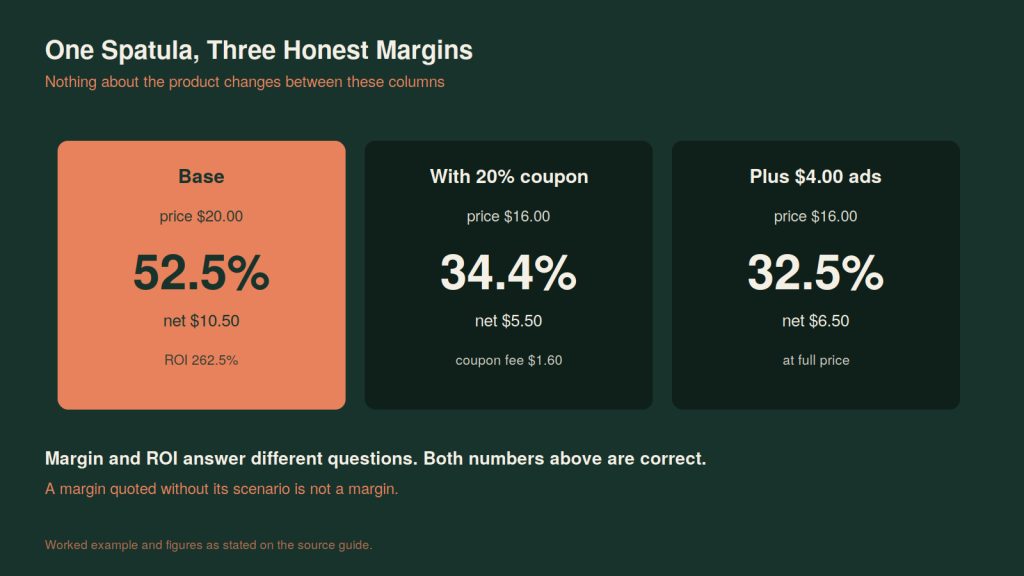
Same spatula, three scenarios, three correct answers.
One product. Three defensible answers. The seller who reports 52.5% is not lying, they are quoting the scenario in which nothing was promoted and nothing was advertised, which describes very few products actually selling.
Where Freight Belongs
The most common way a margin ends up overstated is not a fee error. It is inbound freight sitting outside cost of goods sold.
It feels like a separate expense. You paid the supplier, that is the product cost, and then separately you paid to get it here. Two invoices, two lines.
The federal definition of inventory cost does not work that way. IRS Publication 538 states it directly: “For merchandise purchased during the year, cost means the invoice price minus appropriate discounts plus transportation or other charges incurred in acquiring the goods.” The underlying regulation, 26 CFR § 1.471-3, puts it as adding “transportation or other necessary charges incurred in acquiring possession of the goods” to the net invoice price.
Worth stating precisely: that is the definition of what inventory cost includes, and small taxpayers may be permitted a different inventory method, so this is not a universal filing instruction. But as a way of deciding what belongs in your unit economics it is the right test, and it is the government’s own. If you paid it to get possession of the goods, it is part of what the goods cost you.
On the $20.00 unit above, moving 40 cents of freight out of “overheads” and into the unit cost takes the margin from 52.5% to 50.5%, two full points. Across a catalog, it changes which products you think are working.
Two More Ways the Number Flatters You
Refunds are the second. A 5% return rate reduces the real margin by roughly 1 to 3 points, and it does it after the fact, which is why margin reports run monthly always look better than margin reports run quarterly.
Blended fee rates are the third. Referral fees run from 8% to 15% across most categories and reach 17% in clothing and accessories. Applying one average rate across a mixed catalog produces a portfolio number that is approximately right and individually wrong for every product in it, which is the worst combination available, because it is confident.
What Good Actually Looks Like
Three benchmarks, and they differ by business model rather than by competence.
A healthy FBA margin sits at 15% to 20%. Private label targets 30% and above, which it can because the seller controls the product. Wholesale and arbitrage run at 10% to 15%, on higher turnover and lower capital risk per unit.
Comparing yourself to the wrong benchmark is a real error with real consequences. An arbitrage seller at 13% is doing fine. A private-label seller at 13% has a structural problem, and the number alone will not tell them which one they are.
State the Scenario or Do Not State the Number
The habit worth building is small. When you record a margin, record what was in it: promoted or not, advertised or not, freight in or out, returns modeled or ignored.
Do it for a month and the useful thing that happens is not better numbers. It is that the products whose margins collapse under advertising become visible, and those are the products where the pricing decision was made under an assumption that stopped being true the day you started promoting them.